AI Knowledge Management Agent
Effective AI Knowledge Management is the backbone of modern businesses. By integrating AI Agents, organisations can leverage, organise, and deliver the right information to the right people at the right time. These capabilities rely on modern technologies, predictive insights, and smart automation that support smooth organisational operation and continuous knowledge sharing at scale. This approach helps companies maintain consistent access to reliable information and shifts teams from traditional methods to a more agentic model of automation. Modern agents in knowledge management help simplify complex information flows and reduce repetitive searching.
Knowledge silos slow down your teams
Difficulty finding accurate and up-to-date information
In many organisations, knowledge is scattered across emails, shared drives, intranets, and various tools. Employees spend valuable time searching for accurate and relevant information, and often the content they find is outdated or incomplete. This slows productivity, increases workload, and leads to costly mistakes. Teams often struggle to locate existing knowledge buried across disconnected systems. In any scenario where information is fragmented, teams lose efficiency and struggle to meet rising demand.
Manual knowledge curation, a tedious task
Traditional knowledge management requires teams to manually tag, update, and organise content. Not only is this labour-intensive, but unsustainable as knowledge grows exponentially. As a result, knowledge bases quickly become outdated and underutilised, increasing the risk of inconsistencies and reducing the benefits of structured information sharing. With AI-driven workflows, organisations can optimize document organisation, categorize large amounts of content, and streamline articles that would otherwise require extensive upkeep.T
Inconsistent knowledge sharing between teams
When information is not shared effectively, teams duplicate effort, fail to use historical insights, and risk providing inconsistent information to customers and colleagues. This decreases satisfaction, slows collaboration, and prevents teams from focusing on strategic tasks.
Build AI knowledge management agents to boost efficiency
Empower your teams with Konverso’s GDPR-compliant AI knowledge management agents. These intelligent agents provide automated assistance, semantic search, predictive insights, and AI-powered knowledge retrieval. Combined with automate processes capabilities, they reduce manual effort and improve operational efficiency.
Ready-to-use AI agents
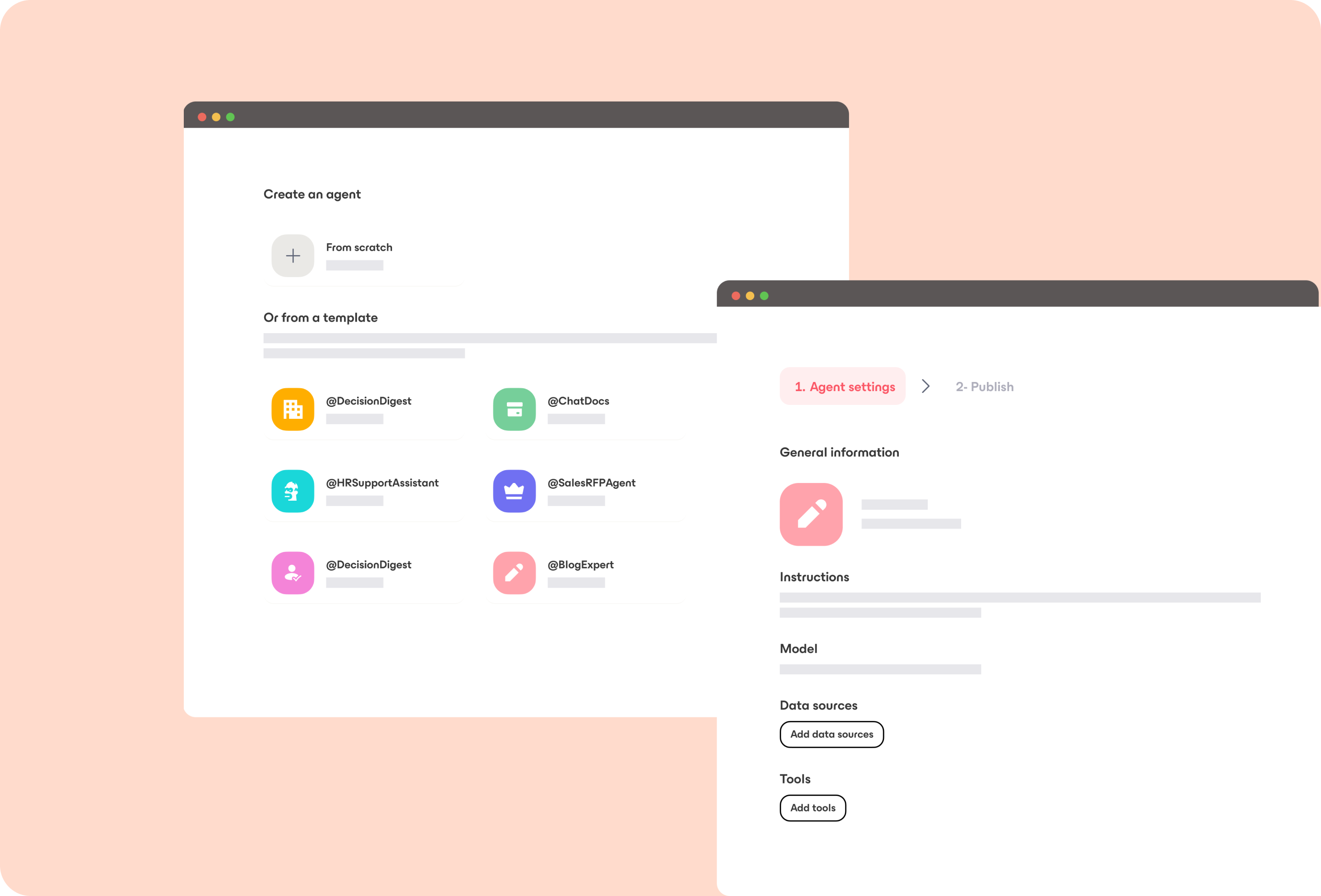
Konverso offers ready-to-use agents at the core of its AI knowledge management tools. These capabilities form the foundation of powered knowledge management used across enterprise teams. They support automating processes, improving internal access to information, and enhancing cross-team collaboration.
It’s as simple as browsing a library, selecting the right agents, and starting the conversation. The platform supports a wide range of use cases, enabling teams to explore new automation opportunities while staying aligned with organisational standards and long-term goals.
An agent for each use case
Content Reviewer
A customer knowledge management agent like such as Content Reviewer assists automates content review, assists with writing, and supports content creation, ensuring documents remain well-structured and accurate.
Tech Writer
This AI agent generates and edits documentation inside your knowledge base, helping teams maintain up-to-date content with less manual effort. This assistant also reduce the need for repetitive tasks, support processing of unstructured content, and ensure information remains current as teams update pages over time.
Create Personalized AI Agents
Do you have specific requirements for your business? Easily design AI knowledge management agents for workflow automation, tailored to your teams' custom use cases.
You can tailor agents to fit specific department needs:
-
Customise and streamline workflows in a step by step manner
-
Train agents using internal knowledge, organisation policies, and unstructured data
-
Build agents in knowledge management tailored to niche teams
Use the agent builder to create agents that exactly match your teams' needs and get them up and running in no time. With scalable models, the platform can transform existing workflows, support high-volume operations, and adapt to different team structures without adding unnecessary effort. You can optimize how information flows across teams by tailoring each agent.
Powerful integrations with your ecosystem
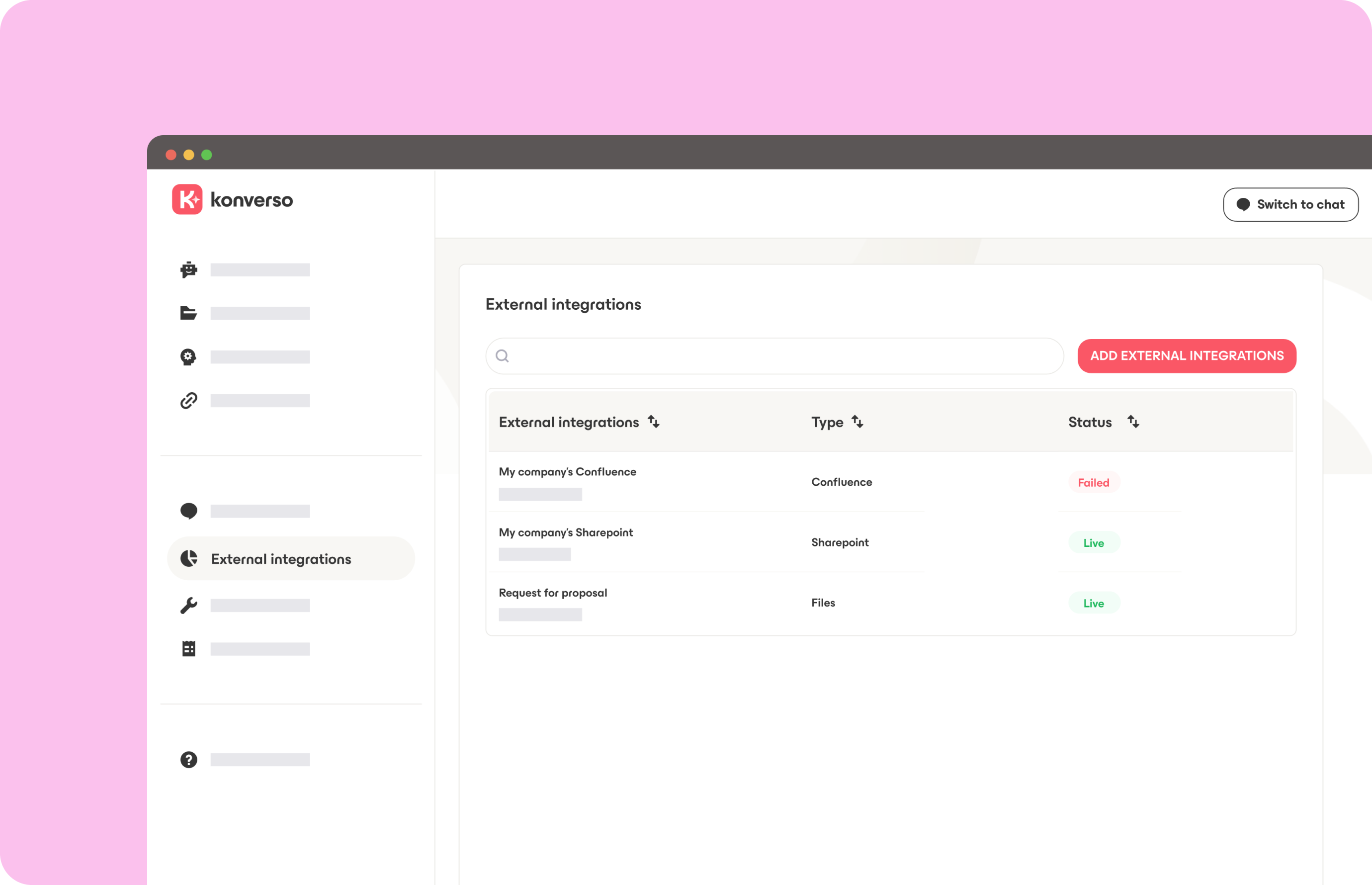
- Confluence, SharePoint, and internal knowledge bases: for knowledge and search systems
- Outlook, Microsoft Teams, Google Calendar: for collaboration and communication platforms
- HubSpot: for CRM platform and customer data platforms
This unlocks a fully connected knowledge management environment that enhances organization-wide information flow. By consolidating tools across the organisation, teams can reduce cost, improve decision-making effectiveness, and maintain smoother collaboration across organizational systems. It supports multi-system environments where information comes from several platforms.
Easily connect your organisation's data to Konverso to feed your agents with your proprietary data and fully leverage the power of our solution.
Hosted in France
The European no-code AI agent platform for your organisation
A fully secure and compliant solution
GDPR-compliant
SOC 2 Type II Certified
Complete data control
The easiest way to deploy AI in your organization
No-code platform
Built-in RAG
Analytics to monitor usage and performance
The easiest way to deploy AI in your organization
What this means for your team
Delegate tasks to AI agents now and start generating an instant return on investment.
greater precision in responses to employee questions
speed on a series of knowledge-related tasks
customer issues resolved per hour
Frequently asked questions (FAQs)
Get answers to common questions about implementing Konverso's AI agent within your teams..
Why should I use AI for knowledge management?
Traditional information hubs often become outdated, scattered, or difficult to navigate. With AI-powered management, your organisation’s repository evolves automatically through machine learning, deep learning, and modern information systems that strengthen how details are organised and represented. Strong knowledge representation ensures information stays coherent across formats and platforms. Teams also learn how to navigate information more efficiently as the system improves.
Advanced lookup features provide quicker and more accurate responses. Personalised suggestions adjust to each person’s role, profile, and needs.
In practice, the system reduces repetitive effort, strengthens company-wide understanding, and improves how insights are shared, helping people make better decisions in real time. These capabilities are driven by intelligent design, advanced vector search, and AI driven models that enhance impact while supporting innovation across knowledge workflows
What are the main advantages of AI-driven knowledge management?
Key advantages include:
• Quicker, more reliable information through intelligent retrieval
• Less staff frustration caused by endless searching
• Better customer experiences and smoother customer-facing exchanges
• Automated updates that fill content gaps
• Greater workflow efficiency thanks to improved documents, tagging, and guided discovery
These gains also reinforce organisation-wide understanding and more effective information practices across departments.
Many organisations also use AI systems to analyse business patterns, understand contextual information, and improve response quality by interpreting multi-layered interaction histories, which helps them optimize workflows and choose the right solution for every scenario.
Can AI knowledge management be integrated into my existing tools?
Yes. Konverso connects with CRM platforms, IT service systems, company collaboration suites, and information libraries such as Microsoft Teams and Confluence.
These connections enable:
• Access to past and current organisational insights
• Easier handling of messy or unstructured material
• A wide variety of automated workflows
• Stronger, AI-enhanced information operations
The platform can also support call-centre teams and streamline customer-facing tasks by connecting multiple workplace systems into one experience.
Is AI knowledge management secure?
Absolutely. Konverso follows strict compliance requirements and enterprise-level security rules so sensitive material stays protected while remaining accessible to approved users.
The system supports:
• Protected company resources
• Secure access to files and records
• Governance aligned with corporate policies
This ensures reliable and responsible adoption across your organisation. This approach helps organisations optimize decision-making, improve engagement, support people more effectively, and strengthen collaboration across departments while maintaining continuous security.
Who can benefit from AI knowledge management?
Companies of any size and across different sectors — including IT, support departments, HR, sales, and service teams — can benefit from this approach.
It helps with:
• Better choices backed by reliable information
• Faster access to what staff need
• Stronger cross-department collaboration
• Less repetitive manual work
• Higher overall productivity in busy environments
Groups dealing with high information volume or frequent documentation updates gain the most. Teams handling product documentation or updates can streamline their processes as well.
What components contribute to effective AI knowledge management?
- Perception and use of tools: AI agents monitor the context and use tools such as APIs and search engines.
- LLM-based reasoning: AI Agents use chain-of-thought and tree-of-thought logic to solve complex problems.
- Content curation: AI Agents automate the tagging, summarisation and organisation of documentary resources.
- Continuous learning: AI agents improve over time through feedback, personalisation, and relevance adjustment.
Together, these components turn traditional processes into a modern, scalable information environment suitable for large organisations. This creates a flexible knowledge studio where teams can refine and expand their information structures.
Is there a trial version available to test the platform before committing?
Yes. Konverso provides a free trial so your staff can explore the system, test capabilities, evaluate performance improvements, and see how AI Agents automate content discovery of your organizational knowledge.
You can also preview information management features and advanced repository functions before you implement AI agentic. Security measures include advanced machine protections, encrypted processing of requests, strict policies, and governance practices that align with international regulations to safeguard internal resources.
You can also request a demo if your team wants a guided walkthrough.
How long will it take for my team to be equipped with AI knowledge management agents?
Setup is fast. Connect your company’s data sources, select or create agents, and launch them within minutes without technical skills.
Konverso supports:
• Guided onboarding
• Integration with company information systems
• Easy control over access, models, and workflows
• Smooth alignment with your organisation’s information structure
The platform is designed for quick deployment, adaptability, and minimal staff effort. These capabilities make it easier to manage articles, maintain detailed reports, and support live updates that reflect the latest organisational changes while improving outcomes across complex workflows.
How does an AI-powered knowledge base improve a company's efficiency?
An AI enhanced repository uses NLP, semantic understanding, and advanced retrieval to help staff find accurate answers instantly.
This reduces:
• Repetitive work
• Duplicate content creation
• Delays in responding to requests
• Inefficient use of the organisation’s information
Overall efficiency improves as automated workflows support content creation, organisation, and upkeep across the company.
These improvements allow companies to watch how performance changes in real time, answer complex queries with greater accuracy, and handle exceptions through process logic that ensures each request is resolved with precision. This not only helps in managing internal employee queries but also help in customer support and customer interactions.
Can generative AI be used for knowledge management?
Yes. Generative AI can produce, refine, and organise material for corporate information systems, supporting:
• Enterprise-wide lookup
• Discovery of new insights
• Steady improvement of knowledge repositories
• Maintenance of automated publication flows
• Creation of up-to-date articles
This makes information easier to share and strengthens collaboration across working groups. It also assissts teams organize large amounts of information, categorize documents, and maintain a unified structure that remains current even as new material is added. It can also summarize this article-level content when teams need quick overviews.
How do AI-based company search and semantic search work?
Semantic lookup and AI-enabled retrieval let employees use natural phrases to find what they need. These systems understand context, recognise routine, and deliver improved results through:
• Smart assistants
• Intelligent information platforms
• Real usage feedback
• Enhanced document-search features
Over time, the system adapts through ongoing user interactions, refining how it delivers information. These capabilities simplify information flow, help staff navigate large volumes of knowledge articles and materials, and improve access across the digital workplace.
AI agents can deliver information from different platforms, provide guidance through virtual interfaces, support workflows, and help organisations explore a wide range of use cases while staying aligned with company standards. The platform can also harness analytics, and support strategic decisions that help leaders guide information initiatives across the enterprise.